
Home > Fireplace Blog > Gas Fireplace Efficiency
A fireplace can look impressive and still do a poor job of heating your home. That gap is what most buyers miss when they start shopping. Flames, finishes, and design get the attention. Gas fireplace efficiency, which actually determines how much warmth you feel and how much you pay to feel it, often gets a quick glance at the spec sheet and a shrug.
That's a mistake. Energy efficiency is what separates a fireplace that costs you money to admire from one that actually offsets your heating bills. It's also one of the most misunderstood numbers in the entire hearth category, partly because several different efficiency ratings get used to describe it.
This guide breaks down what efficiency really means for gas fireplaces, what those ratings tell you, what they don't, and how to get more usable heat output from whatever model you choose.
What gas fireplace efficiency actually means
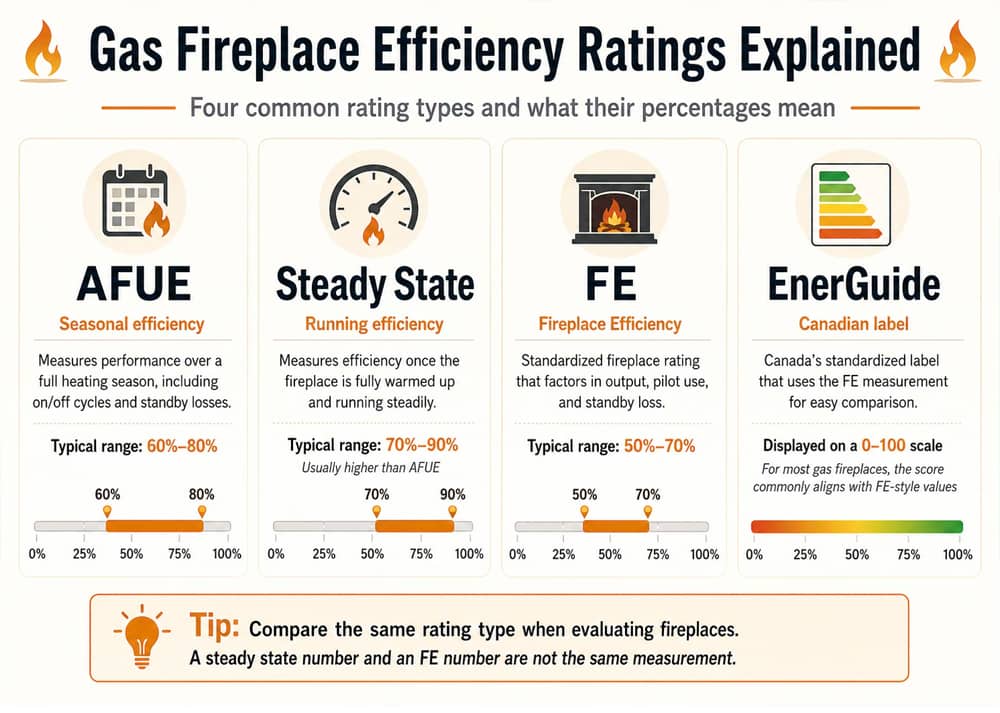
Gas fireplace efficiency is the percentage of fuel energy a fireplace converts into usable heat for your home. A natural gas fireplace rated at 75% efficiency turns 75% of the natural gas or propane it burns into heat that reaches your living area. The other 25% is lost through venting, standby heat loss, or incomplete combustion.
Several efficiency numbers get used, and they don't all measure the same thing. Three of them are actual measurements. The fourth, EnerGuide, is the Canadian label that reports one of those measurements.
AFUE
AFUE stands for Annual Fuel Utilization Efficiency. It measures efficiency across an entire heating season, including on/off cycles and standby losses. It is the most realistic number for year-round performance. Most gas fireplaces fall between 60% and 80% AFUE.
Steady state efficiency
Steady state efficiency is a snapshot of how efficient the fireplace is once it's running and warmed up. It is always higher than AFUE because it ignores cycling losses.
Fireplace efficiency rating
The Fireplace Efficiency rating, or FE, is a standardized measurement based on the CSA P.4.1-02 test method. It factors in steady state output, pilot light energy use, and standby loss. Units on the market generally range from about 30% to 70% FE, with many newer models landing in the 50% to 70% range.
EngerGuide
EnerGuide is Canada's official efficiency labeling program, administered by Natural Resources Canada. It doesn't measure anything new. It takes the FE rating and displays it on a standardized scale so you can compare models side by side. Two things are worth getting straight: the FE testing behind the rating (CSA P.4.1-02) is required for every gas fireplace sold in Canada, but the EnerGuide label that prints that number on the brochure is voluntary. When a manufacturer shows it, comparison is easy. When they don't, ask for the FE figure directly.
When you compare two fireplaces, you want to compare the same rating type. A 78% steady state number and a 68% FE number aren't telling you the same thing, even though they describe the same unit.
How efficient are gas fireplaces, really?
The honest answer: it depends heavily on the type.
Open wood burning fireplaces are the baseline most gas units are measured against, and they're a low bar. Many actually lose more heat than they produce, pulling warm air out of the room and up the chimney.
Direct vent gas fireplaces, the most common premium category, typically run between 70% and 85% efficient. Sealed combustion keeps heated air in and cold air out. Premium direct vent units with advanced heat exchangers push into the high 80s.
B-vent, or natural vent, fireplaces are older technology. They pull room air into the firebox and send a portion of the heat up the chimney. Efficiency usually lands in the 40% to 60% range. Cheaper, but they bleed warmth.
Vent-free or ventless models post the highest efficiency numbers on paper, often 90% to 99%, because nothing is vented outside. Natural Resources Canada and many building codes flag them for indoor air quality and combustion safety concerns, including carbon monoxide risk. They aren't sold in Canada and are restricted in many US states. Higher efficiency on paper doesn't always translate to a better choice for your home.
A gas fireplace insert retrofits an existing fireplace, converting an old wood burning setup into a far more efficient heat source. A quality gas insert generally runs 70% to 80% and dramatically outperforms the open masonry wood fireplace it replaces, often using the existing chimney as a venting pathway.
If you want a deeper breakdown of heat output in actual BTUs, our guide on how much heat you actually need walks through sizing in plain terms.
What affects gas fireplace efficiency
The rating on the brochure is a starting point, not a guarantee. Several factors decide how much of that rated fireplace efficiency you actually get in your home.
Venting Type
Sealed direct vent systems are the biggest single efficiency driver. They use a coaxial pipe with an outer pipe that draws fresh air in for combustion and an inner pipe that carries exhaust gases out. The result: no warm air from your living area is pulled up the chimney. See our venting guide for a full comparison.
Pilot System
Standing pilots burn 24/7 and quietly drain efficiency over the year, raising gas consumption and operating costs. Electronic ignition, sometimes called intermittent pilot ignition, only fires when the pilot light ignites at startup, so the unit isn't burning gas around the clock.
Heat Exchanger and burner design
This is where premium and budget fireplaces diverge. A well-engineered heat exchange system captures more BTUs from the gas burners before they exit the vent. Features like Valor's AutoFire system optimize this automatically.
Sizing
An oversized fireplace spends most of its time at low output trying to avoid overheating the room, which is an inefficient way to operate. An undersized one runs at maximum constantly without ever warming the space properly. Right-sizing for square footage and ceiling height matters more than most buyers realize.
How You Operate It
Running a fireplace on high for short bursts is less efficient than running it at a steady, moderate output. A thermostat or timer keeps things consistent.
Why radiant heat changes the efficiency conversation
Most efficiency discussions stop at combustion. How much of the fuel becomes heat? That's only half the story. The other half is whether that heat actually reaches you.
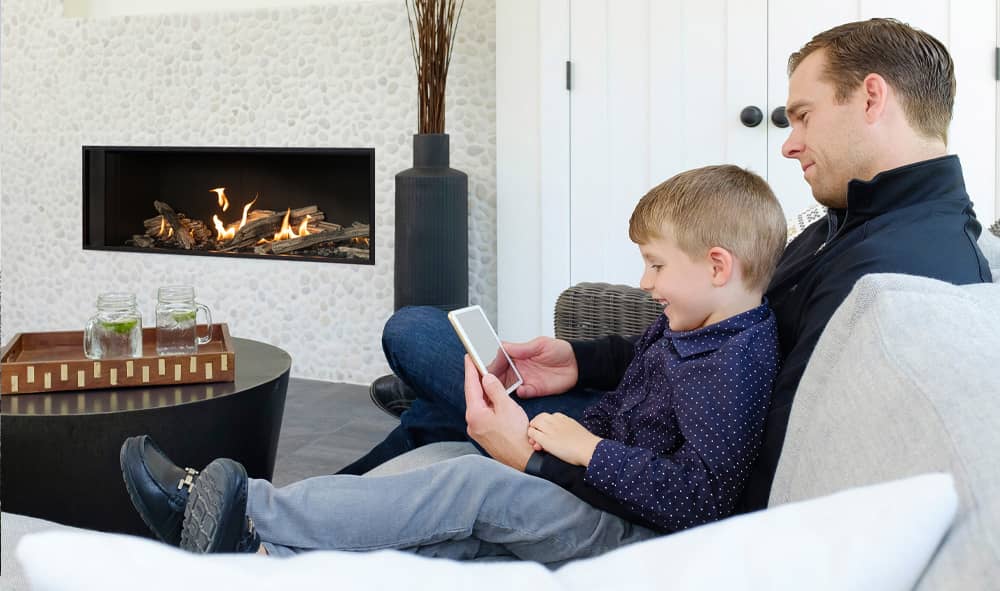
Convection-heavy fireplaces warm the air, which then circulates around the room. Most of it rises to the ceiling first. You feel warmth eventually, but a lot of it sits where you aren't.
Radiant heat works differently. It transfers warmth directly to people, furniture, and surfaces in front of the fireplace through the glass front, the same way the sun warms your skin on a cold day. You feel real heat immediately, even if the room air temperature hasn't fully caught up. This is the principle behind Valor's science of warmth approach.
The practical implication: an energy efficient gas fireplace built around radiant delivery at 80% often feels warmer than a convection-heavy unit at 85%, because more of the heat reaches the people in the room instead of pooling at the ceiling. When you're evaluating efficiency, ask how the heat is delivered, not just how much of it the fireplace produces.
Gas fireplace vs. furnace efficiency
A modern high-efficiency natural gas furnace runs at 90% to 95% AFUE, sometimes higher. Gas fireplaces top out lower. On paper, the gas furnace wins.
In practice, the comparison isn't that simple. Central furnaces heat the whole house through ductwork, including other rooms nobody is using. Ducts also lose heat. The Department of Energy estimates that a typical duct system loses 20% to 30% of the air moving through it to leaks and poor connections, so not all of that furnace heat reaches the rooms you're actually in.
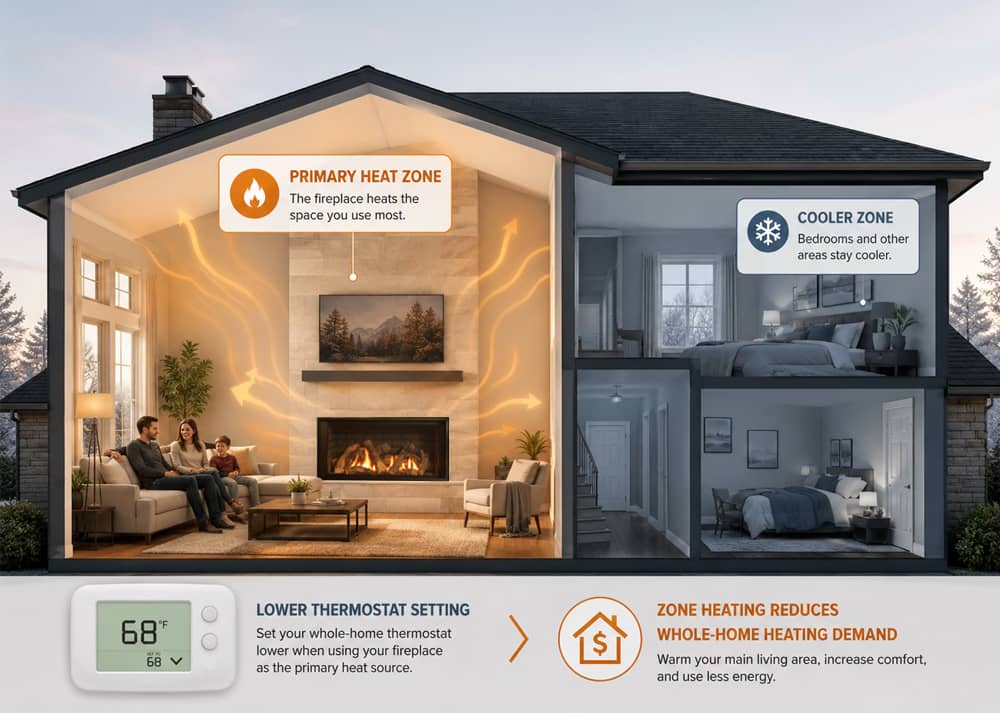
An efficient gas fireplace can provide heat directly to the family room or living area you're in, with no duct losses. That's zone heating: turning the central heating thermostat down and using the fireplace as a supplemental heat source where you actually spend time. The result is often lower whole-home energy consumption and lower heating bills, even with a lower AFUE rating on the unit itself.
Pairing strategies matter too. A gas fireplace and a heat pump can work together as an efficient heating duo in colder regions, with the heat pump handling mild to moderate days and the fireplace stepping in when temperatures drop and heat pump efficiency falls off.
There's also a resilience factor that doesn't show up in any efficiency rating. Some gas fireplaces operate without household power, which means they keep working during a power outage when furnaces don't. Efficiency you can't access during a cold-weather grid loss isn't worth much.
How to get the most heat out of your gas fireplace
Even an efficient fireplace underperforms if you use it poorly. A few habits make a real difference and lower your operating costs.
Use zone heating intentionally
Drop the central thermostat by 5 to 10 degrees and run the fireplace in the room you're occupying. Heating a single room with a fireplace uses far less energy than heating every room of the house through a furnace. The bigger the temperature gap between your zone and the rest of the home, the more you save.
Run it at moderate output, not max
Fireplaces are more efficient at sustained moderate burn than at full blast for short bursts.
Use a thermostat or timer
Modern controls let the fireplace cycle based on room temperature instead of running flat out. Less waste, more comfort, lower gas consumption. A ceiling fan on low can help distribute heat to other rooms without forcing the fireplace to work harder.
Maintain it annually
A dirty burner, fouled pilot, or partially blocked vent drops efficiency quickly and can lead to harmful emissions. Annual service by a qualified technician keeps everything running at spec.
Size it correctly from the start
Oversized units run at low output most of the time and lose efficiency. Undersized ones run flat out without ever warming the space. A dealer can help you size a fireplace appropriately for your specific room.
What to look for when buying an efficient gas fireplace
If energy efficiency is a real priority, here's what actually matters when you're shopping.
- Direct vent construction. Non-negotiable for sealed combustion and minimal heat loss. Vented properly through an outside wall, the system stays sealed from your indoor air.
- Electronic ignition over a standing pilot light. A standing pilot burns continuously and typically uses 800 to 1,500 BTUs per hour year-round. That works out to roughly $50 to $150 in wasted gas annually, depending on local rates. Electronic ignition eliminates that standby burn.
- A high FE or EnerGuide rating. Look for 70% or higher. In Canada, the EnerGuide label makes comparison easy when it's shown.
- Radiant heat delivery. A unit engineered to radiate real heat into the room, not just warm the surrounding air.
- A quality heat exchanger. Often the difference between mid-tier and premium efficiency.
- Smart controls. A thermostat, timer, or remote control to optimize run time.
- The right BTU for your space. Not the biggest number. The right number.
- A reputable dealer. Someone who can advise on sizing and installation, because a great fireplace installed wrong loses efficiency fast.
Before you book a showroom visit, our complete gas fireplace buying guide covers the broader decision-making process from fuel type to design.
The bottom line
Gas fireplace efficiency isn't a single number. It's a combination of how well the unit converts fuel into heat, how well that heat reaches you, and how smartly you use it day to day. The brochure rating tells you part of the story. Venting type, ignition system, heat delivery method, and your own habits decide the rest.
When you evaluate a fireplace, look past the headline percentage. Ask about the rating standard, the venting design, the ignition system, and whether the heat is delivered radiantly or only by convection. Those details separate a fireplace that warms a room from one that just looks like it should.
If you're ready to compare options in person, find your local Valor dealer to talk through sizing, venting, and the right efficiency fit for your home.
Table of Contents